CHALKBEAT: A network of public microschools wants to expand across Indiana. Is it collaborating or competing?

CHALKBEAT: A network of public microschools wants to expand across Indiana. Is it collaborating or competing?


By Aleksandra Appleton, Chalkbeat Indiana

Jen Shipley would have never considered public school for her rising third grader, whom she had homeschooled since kindergarten.

In public schools, she said she saw cuts to recess and enrichment, an overreliance on screens, and not enough time to give each student individual attention, she said.

But a 2025 meeting with Indiana Microschool Collaborative CEO George Philhower and Nature’s Gift microschool leader Erin Wolski changed her mind. They painted a picture of a public school located in the woods in Hancock County that would emphasize parental involvement and a flexible schedule, while drawing from Montessori and classical education to allow students to move at their own pace.

Over the next school year, Shipley’s daughter excelled in math where she had been struggling at home. It was hard to leave their full-time homeschooling community, but Shipley said it was worth it.

“I love that she can learn from teachers who love teaching reading and math,” Shipley said. “Sure I could teach my child a science experiment, but not with the same passion behind it.”

Nature’s Gift’s, which just wrapped up its first year, is the Indiana Microschool Collaborative’s first microschool. But the collective plans to open five more sites with spots for hundreds more students across eastern central Indiana. Planned sites in Richmond and New Palestine already have waitlists for admission, a sign that parents’ interest in microschools continues to grow.

The collaborative’s approach is distinctive — and not just for its education model. In fact, the Indiana Microschool Collaborative, or IMC, could be a harbinger of how emerging models for schooling in the state will increasingly blur traditional lines.

It’s a network of microschools, which operate with a degree of independence, but it’s also classified as a single charter school in terms of state funding. And it doesn’t just draw on resources and services from a traditional school district — its CEO, Philhower, is also that district’s superintendent.

Eastern Hancock Schools, a rural district serving around 1,200 students across three schools, provides administrative support to Nature’s Gift through a shared services agreement. However, the charter school is an independent entity and authorized by the Indiana Charter School Board.

Philhower envisions Indiana microschools working collaboratively with their local districts to offer families an alternative to leaving the public school system altogether. For families, this opens up possibilities like learning at home some days and learning in a classroom on others, while districts still earn some revenue from providing facilities or administrative support.

“At a broader level, the goal is not to create separation between schools but to create more connected and flexible public learning opportunities for families,” Philhower said.

Not everyone is so taken with the idea. Some Indiana superintendents have spoken to the collaborative about bringing microschools to their districts, said Jeff Butts, of the Indiana Association of Public School Superintendents. But the collaborative’s Richmond site has been criticized by the superintendent of the local school district, who said losing students to IMC would lead to district funding cuts and staff reductions.

That kind of financial crunch would hit rural districts especially hard, said Cathy Fuentes-Rohwer, president at Indiana Coalition for Public Education.

Then there are broader concerns about whether such arrangements are appropriate or fair. Fuentes-Rohwer questioned how Philhower can promote both the district and the collective and serve both well.

“Charter schools are based on the idea that the public schools are failing to provide something for kids. Your job as a superintendent is to fix that, and provide what’s needed so that every student can be the best that they can be,” Fuentes-Rowher said. “If it’s about smaller class sizes or individualized attention, why is that not provided to all kids at the district?”

Philhower said he believes in school choice, and that all students should get to attend “a school that feels like it was designed for them.”

“Nothing is stopping us from providing that. One benefit to Eastern Hancock is we get to learn from these sites,” he said. “And these sites get to learn from us.”

Funding and operating microschools throughout the state

Indiana’s microschools have operated mostly as small private schools, although in 2023, Purdue Polytechnic High School opened the Lab School, a microschool within a public charter school serving around 20 students

The microschools’ approaches share an emphasis on small environments and personalized instruction. But with small staffs, there are some tradeoffs.

At Nature’s Gift, parents pick up and drop off every day. The school can incorporate some special education goals into small group instruction, but other services for students with an Individualized Education Program might be offered virtually, school leaders said. That format might not be appropriate for every student.

Each IMC site serves between 60 and 100 students, and will have “its own educators and identity that fits the local community,” Philhower said, though there is collaboration with districts “around professional learning, systems, curriculum design, and student experiences.”

Under Indiana law, IMC could be eligible to receive local property tax revenue from multiple districts. Philhower said IMC has not discussed participating in a referendum, and would only participate if its partner districts wanted the school to do so.

For state funding purposes, IMC is one big charter school, Philhower said. That also means the new locations are not subject to an Indiana law that requires charter authorizers to hold public hearings before granting charters to new schools.

That left local education leaders in one county blindsided.

Wayne County superintendents were not included in IMC’s plans to open a microschool on the campus of Indiana University East in Richmond this fall, said Mike McCoy, superintendent of the local district, Centerville-Abington Community Schools.

Philhower said the school works with its authorizer, the Indiana Charter School Board, on hearings. The board did not respond to a request for comment.

In a statement, IU spokesman Mark Bode said IU East shared initial information about the new school in late March, followed by a meeting with the superintendents in April.

If he had been asked for input, McCoy said he would have suggested a model within a district that would allow students to stay with their peers while also taking classes at the university. His district already sends some students to IU East for a teaching pathway and other college courses.

Enrollment in Centerville-Abington, which has about 1,700 students, has fallen in the last several years due in part to local demographic changes, McCoy said.

Philhower said it makes sense for districts with declining enrollments to work with IMC schools instead of merely losing those students. After dipping slightly during the pandemic, enrollment in Philhower’s Eastern Hancock district has recovered to where it stood a decade ago.

But McCoy said a loss of even 10 students to a microschool could force his district to cut a teaching position.

“Schools in Wayne County, we’re working together more than we ever have,” McCoy said. “It’s unfortunate that we’re going to lose students.”

What teaching and learning at a microschool is like

On a recent Friday, Nature’s Gift students boarded an Eastern Hancock school bus for a field trip to the Conner Prairie museum.

The school paid Eastern Hancock schools for the gas and the cost of the driver’s time for the field trip, said Wolski, the school leader. Two Nature’s Gift teachers planned the outing. (Eastern Hancock does not provide daily transportation to and from the school.)

Teachers at Nature’s Gift don’t typically spend the whole day with just one group of students; Wolski is the licensed teacher for the middle school, but might also pull aside a group of five second graders for additional reading instruction, she said.

“I don’t feel like I’m on an island, and my whole career, I felt like I was on an island,” said Wolski, who previously spent 16 years teaching in both general education and special education roles.

Wolski said IMC hopes to add a special education coordinator in the future to be able to offer more services — like identification — in-house, rather than relying on Eastern Hancock.

The group instruction at the school is based on skill level, so it’s easier for students to move at their own pace, Wolski said. A first grader recently joined her math group for third to fifth grade students.

These learning groups might include approximately a dozen students at a time, though the school comes together in larger cohorts to work on Project Lead The Way curriculum.

Some students attend in-person only part-time, and complete the rest of their instruction at home. The flexibility allowed Shipley’s daughter to attend Nature’s Gift in person three days a week, leaving time to attend a wilderness school program while completing schoolwork at home.

“We are always thinking about outside the box ideas,” Wolski said. “When you work closely with parents, you have that partnership, and you can problem solve a lot easier.”

***

Chalkbeat is a nonprofit news organization covering public education, https://www.chalkbeat.org/indiana/2026/06/22/microschool-network-expands-to-new-sites/

CHALKBEAT: Indiana wins federal education funding waiver from Trump administration
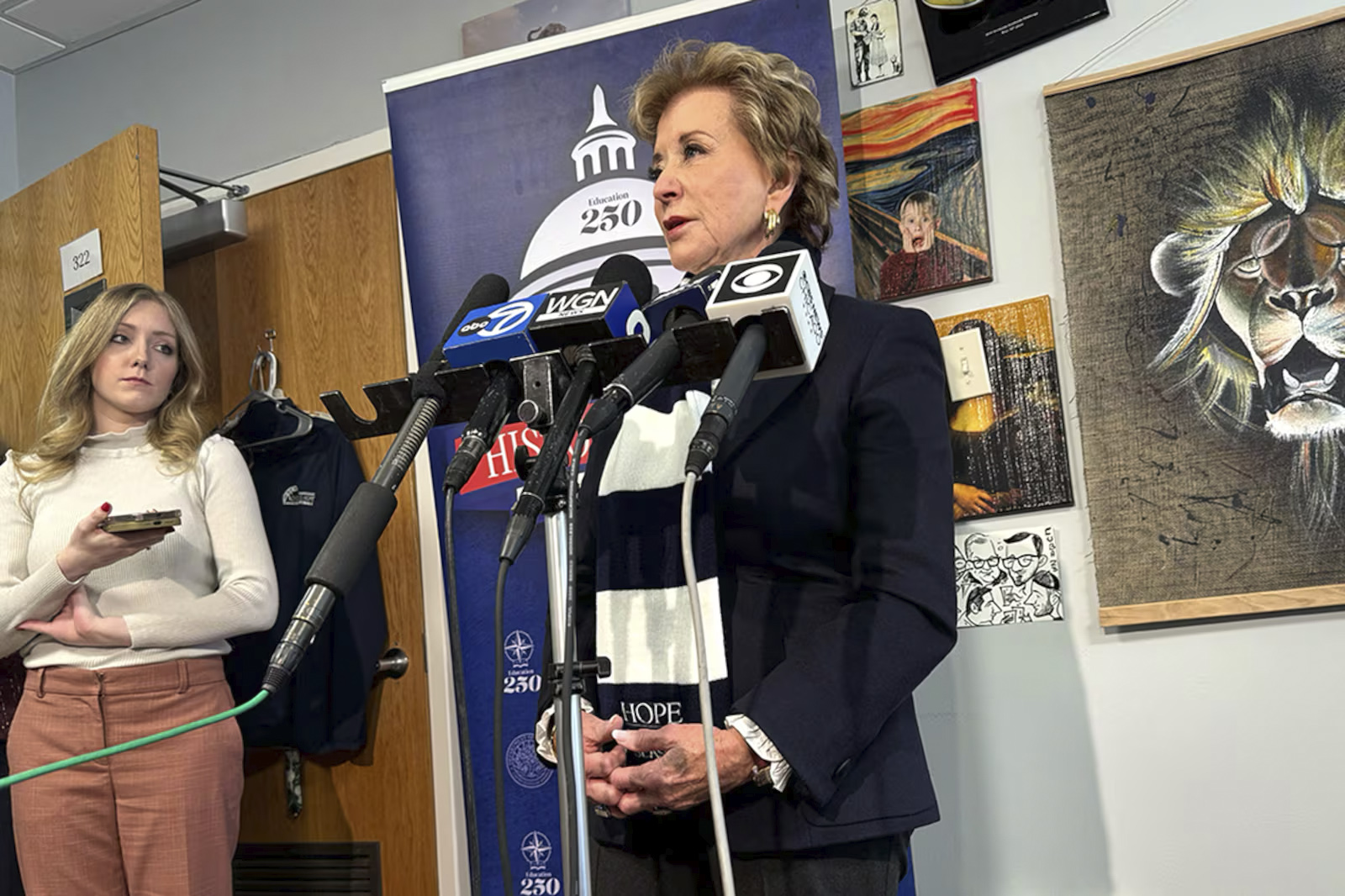
U.S. Secretary of Education Linda McMahon announced Tuesday that Indiana is getting some flexibility from standard requirements for federal education funds. (Reema Amin / Chalkbeat)

CHALKBEAT: Indiana wins federal education funding waiver from Trump administration


By Aleksandra Appleton, Chalkbeat Indiana

The Trump administration is giving Indiana new flexibility in how it spends some of its federal education funding.

But the waiver from the U.S. Department of Education is not nearly as expansive as what Indiana requested last year, when it sought a waiver from some provisions of the Every Student Succeeds Act, the main federal law governing K-12 education.

The approved waiver will merge five federal funding streams to the tune of around $50 million over the next four years, according to U.S. Secretary of Education Linda McMahon, who spoke at a news conference with Indiana Secretary of Education Katie Jenner and Indiana Gov. Mike Braun on Tuesday.

This strategy for federal education funding, often referred to as a block grant, is popular among conservatives championing fewer regulations. But others have criticized it, saying it could weaken accountability for the money and ultimately hurt certain students.

Indiana is now the third state after Iowa and Louisiana to receive a “Returning Education to the States” waiver from the Trump administration, which has also sought to close the Education Department. The flexibility the department provided to Iowa was also more modest than what the state originally sought.

McMahon and Jenner said the move will save Indiana an estimated $20 million in compliance costs over four years associated with administering the grants separately.

“As states, we have significant control over education. We set standards, choose our curriculum, and design assessments. When it comes to federal funding, our hands have always been tied, until now,” Jenner said.

The waiver will also allow the state to use its newly approved school accountability model as the sole accountability model for state and federal purposes.

At the state level, the waiver will merge the following funding streams:

  • Title I, Part B grants, which cover assessment.
  • Title II, Part A grants, which cover professional development.
  • Title III, Part A grants, which cover education for English learners.
  • Title IV, Part A grants, which cover enrichment.
  • Title IV, Part B grants, which cover 21st Century Learning Centers.

The federal funding for these grants will not change under the waiver.

The waiver does not grant all Indiana districts similar flexibility to spend the money they receive from the state, as the state originally requested in its waiver application. Instead, it allows the state to create a pilot program for up to 15% of local education agencies that will allow them to merge Title II, Part A and Title IV, Part A funds.

The waiver also does not address Indiana’s request to redirect School Improvement Grant funding away from schools identified as low-performing. That request would have potentially diverted $25 million in annual federal funding to other schools, like charter schools and microschools.

Education advocates had expressed concern that this move would have hurt students who have to stay at the schools identified as low-performing.

Similarly, critics have also said that merging dedicated federal funding streams for specific student needs into block grants risks losing the guardrails that ensure the funding reaches those students.

Denise Forte, president and CEO of The Education Trust, an advocacy group that tracks the status of state waiver requests, said in a Tuesday statement that the Trump administration “has abandoned” commitments to supporting students and schools and to publicly reporting important education data.

“Instead, the Department of Education will allow Indiana to rewrite its accountability system in a way that will mask student performance and move millions of dollars in dedicated funding away from students who need it most,” Forte said.

Indiana officials on Tuesday rejected such arguments.

“Our funding formulas … direct a certain number of dollars per student to every school. That money will continue to flow,” Jenner said. “Now the money will be able to be deployed exactly how they need it in a timely manner.”

***

Chalkbeat is a nonprofit news organization covering public education, https://www.chalkbeat.org/indiana/2026/06/16/trump-administration-grants-federal-funding-and-accountability-waiver/ 

CHALKBEAT: Treasury Department preview of tax credit scholarship rules suggests limited role for states

CHALKBEAT: Treasury Department preview of tax credit scholarship rules suggests limited role for states


By Erica Meltzer, Chalkbeat Colorado

States most likely will not be able to place additional requirements or guardrails on scholarship groups funded through the new federal tax credit, according to a preview of the rules provided by the U.S. Treasury Department this week.

This position contradicts comments Education Secretary Linda McMahon made to Congress last month and at a Michigan school choice event in March in which she said states would be able to shape their own programs.

The U.S. Department of Education has declined to clarify those remarks, but it is ultimately the Treasury Department that will set the rules for the program.

And in remarks made Tuesday at a closed-door meeting and later released by the Treasury Department, Deputy Assistant Secretary for Tax Policy Kevin Salinger said that states may not impose “substantive” rules on scholarship groups that are more restrictive than federal law.

That’s welcome news for school choice groups who want more flexibility and limited rules for scholarship groups.

It may present a dilemma for Democratic governors who have said they are waiting to see these rules before deciding whether to opt in.

One of the key questions for this group has been whether they’ll be able to shape the program by putting additional rules on scholarship groups, requiring, for example, that they serve low-income families and students with disabilities or meet certain academic standards. Some Democrats have indicated they want the money only to go to public schools.

“I am never going to leave money on the table when it comes to supporting our kids in public schools,” Maryland Gov. Wes Moore said last week at the Education Writers Association conference in Baltimore when asked about the tax credit. But Moore said he was waiting on the regulations to decide whether to participate. “I do not believe that we should be taking public dollars and putting them towards private education.”

Salinger’s remarks indicate states will not be able to shape the program as they see fit, contradicting the administration’s promise to “return education to the states.”

Set to launch in 2027, the federal tax credit scholarship allows individuals to donate up to $1,700 to eligible nonprofits and get fully reimbursed through a federal income tax credit. The scholarship groups can provide vouchers to families earning up to 300% of the area median income to spend on educational expenses. Those expenses could be private school tuition, tutoring for a public school student, or specialized equipment or therapies.

Governors can decide whether their states participate, and those who do must submit lists of eligible scholarship organizations each year. Federal law imposes only minimal requirements, for example that scholarship groups operate as federally recognized nonprofits and provide money to students who attend more than one school.

The closed-door event at which Salinger spoke included a panel on ways public school students could also benefit.

Speaking at a separate Chalkbeat Ideas event Thursday, Rhode Island Education Commissioner Angélica Infante-Green said Democratic states should be open to possibilities, such as scholarships funding afterschool tutoring through approved vendors.

“This is not money that we would have,” she said. “This is money that, instead of going to the federal government, could come to our state.”

Another question has been whether homeschool families can benefit. That’s likely to be determined by whether state law considers a home school to be a school in a legal sense.

Sailnger laid out other aspects of the rules that school choice groups have been watching carefully, clarifying that they can operate in multiple states and that caps on administrative costs won’t apply to their entire budgets, only to money they raise for scholarships.

The rules will be finalized by the end of September, Salinger said.

Large national scholarship groups hoped for this flexibility so they can expand and serve more families.

“We have gotten our clearest signs from Treasury yet that this tax credit is going to benefit all students across all sectors,” said Ashling Preston, director of federal affairs for the American Federation for Children. “Every governor has the information they need to opt in right now. There are hundreds of millions or even billions of dollars at stake in every state.”

But Augustus Mays, vice president for partnerships and engagement at the progressive advocacy group EdTrust, said the preview of the rules only reinforces his belief that Democratic governors should opt out.

“If you’re a governor and you think you’ll be able to have the authority to shape this program to align to your public school priorities,” he said, “the answer is no, you’re not going to have that authority.”

***

Chalkbeat is a nonprofit news organization covering public education, https://www.chalkbeat.org/2026/06/11/treasury-previews-tax-credit-scholarship-rules-that-shape-school-choice/

CURRENT: Accountability grades return for Indiana schools

CURRENT: Accountability grades return for Indiana schools

School districts in Indiana will receive an accountability grade as the Indiana State Board of Education approved a new system to evaluate schools earlier this year.

It marks the return of the A-F grade system that was paused five years ago. The new system focuses on student achievement metrics, like earning high school credits, taking dual credit and AP classes, performing well on ILEARN and meeting an attendance goal.

Greg McDaniel, coordinator of school services at Zionsville Community Schools, said the new grading system is meant to consider more factors than only a standardized test.

“This was designed to hold schools accountable for serving every single child, and that’s a wonderful thing,” he said. “We might not agree how they got there, but it’s a great thing and thought process.”

Schools will receive their first grades in the fall, based on this school year. Grades will be assigned to each district’s third grade, 10th and 12th grade, fourth through eighth grade, each school building and an overall district grade.

The first round of grades is for baseline purposes. There will be no consequences to this year’s grades. It is also unclear what consequences will be for low performing schools. It’s one of many details schools are still waiting on. ZCS Superintendent Rebecca Coffman said more guidance is expected from the Indiana Department of Education later this year.

Each student will receive a score based on a combination of metrics deemed academic mastery and additional knowledge. The scores will be used to determine letter grades for schools.

Metrics differ for what group of students are evaluated. For example, for 10th graders, credits earned as a freshman and earlier factor into the letter grade as does credits for specific subject areas like English and math, and taking dual credit, career and technical and AP courses.

“The whole idea behind school accountability was to push kids learning down further to open up opportunities at the top end, specifically work based learning, among other things,” McDaniel said in a presentation to the school board April 13.

College readiness factors, such as SAT performance, is a focus for evaluating a school’s 12th grade.

“We are going to be a school that gets advantaged by this,” McDaniel said. “This is going to help us.”

More than 90% of Zionsville Community High School students go to college.

The new grading system considers a high school student who earns a diploma seal to be at expectations. Above expectations, which would be scored higher, would require a student to earn a plus seal. A plus seal is more demanding, including several, sometimes more than 100, hours of work-based learning.

“That is going to be a challenge for high schools across the state,” McDaniel said. “It just will because there is a lot you have to do to get into that plus category.”

The seals are part of the state’s new graduation requirements that replace the old Core 40 and academic honors diplomas. The new requirements apply to the class of 2029.

The accountability model also weighs a student earning an academic honors diploma (the old diploma model applies to students who will graduate before 2029) as meeting expectations.

“They are setting up a system that says if you get an academic honors diploma you are, at best, a B student,” McDaniel said. “That’s pretty rigorous. That’s something that has made us uncomfortable.”

Accountability grades for fourth through eighth grades will be tied to ILEARN scores, demonstrating growth and soft skills. McDaniel said the state is developing an employability, soft skill test for these grades.

School board vice president Michael Berg said the accountability grade system will be biased toward communities like Zionsville, where parents have the time and means to invest in their children. He argued the system will create an environment that is critical of public education and places unachievable goals on certain districts.

“Just something I think that we need to be paying attention to as we look at the shifting landscape of public education,” he said.


BY

WTHR: Indiana nonprofit launches campaign to educate parents on school vouchers

WTHR: Indiana nonprofit launches campaign to educate parents on school vouchers

The window for parents to apply for Indiana's Choice Scholarship Voucher Program opened this week.

The program gives Hoosier parents money from the state to send their kids to any school they want.

A local organization is launching a program to connect more families with those vouchers and schools with open spots.

The Institute for Quality Education, a nonprofit K-12 policy organization, would like to see more Hoosier parents take advantage of school vouchers, since the Indiana General Assembly moved to universally fund them starting in the 2026-2027 school year.

This week, the institute launched the "Find Your Fit" enrollment campaign to educate families about vouchers and their educational options for their kids.

"It's really to try and marry parents and families who are looking for a better educational fit, defined by however that might be for them, right?" said Betsy Wiley, with The Institute for Quality Education.

Right now, according to Wiley, there are 9,000 open seats at non-public or private schools across the state.

Still, Wiley said the institute's research shows that six out of 10 Hoosier parents still don't know they have access to state funding to send their child to whichever school they think is the best.

Wiley is hoping the Find Your Fit campaign, which is partnering with 75 schools, can change that.

"What we're really doing with the Find Your Fit campaign is trying to make sure that families and students that are looking for a different or better educational opportunity are being introduced to schools that want to serve them and really trying to be that facilitator to make sure that they are finding their fit," Wiley said.

Not all policymakers are fans of the expansion of universal school choice in Indiana.  Democratic lawmakers have repeatedly expressed concern that the expansion of the state's voucher program comes at the expense of public school funding.

The Indiana Coalition for Public Education shares that position.

"For every child that uses a voucher to attend a private school, whether they've ever attended a public school or not, means fewer dollars left for the public schools that they would otherwise be served in," said Joel Hand, with the Indiana Coalition for Public Education.

Supporters of the voucher program, including Republican lawmakers have said that state dollars follow the student to fund students' education, not systems.

Hamilton County Reporter: Gov. Braun opts in to new federal tax credit for school choice scholarships

Hamilton County Reporter: Gov. Braun opts in to new federal tax credit for school choice scholarships

Indiana Governor Mike Braun announced last Thursday, Jan. 22 that Indiana is opting into a new initiative, which will allow Hoosiers to collect federal tax savings for investments made in K-12 scholarships.

The new federal tax credit, established under President Trump’s One Big Beautiful Bill, applies to charitable contributions made to Scholarship Granting Organizations (SGOs) that serve eligible K-12 students.

“Parents are in charge of their children’s education,” Gov. Braun said. “As a state, we are prioritizing that through universal school choice and a state tax credit for donations made to scholarship granting organizations, which helps make a high-quality education accessible and affordable for every Hoosier family. Under President Trump’s leadership, we welcome this increased focus on school choice at the federal level and are ready to leverage this additional, federal tax credit to expand opportunities for students and families across our state.”

Governor Braun visited Saint Philip Neri Catholic School to mark the occasion of opting into the new federal tax credit that will help parents remain in the driver’s seat of their children’s education. Gov. Braun spoke with teachers, and students showed him some of their most recent projects.

Families can access scholarships through eligible SGOs to support qualified educational expenses, including costs incurred for children at public and private schools, such as tuition, fees, tutoring, educational therapies, transportation, technology, etc.

Beginning Jan. 1, 2027, individuals will be eligible for a nonrefundable federal tax credit of up to $1,700 for contributions to participating SGOs. Any unused credit may be carried forward for up to five years. The below Indiana-based SGOs have already indicated they plan to participate in the new federal tax credit program in 2027; others may continue to be added:

  • Institute for Quality Education, Inc.
  • Sagamore Institute Scholarship for Education Choice
  • The Lutheran Scholarship Granting Organization of Indiana, Inc.
  • School Scholarship Granting Organization of Northeast Indiana, Inc.
  • Legacy Foundation


“Every child is unique, and Indiana is home to a variety of high-quality educational options to meet those needs, regardless of a family’s income or ZIP code,” Indiana Secretary of Education Dr. Katie Jenner said. “This new federal tax credit will continue to drive investments in scholarships, ensuring high-quality educational opportunities are within reach for every learner, in an environment that helps them reach their greatest potential.”

The State of Indiana also offers a 50 percent tax credit for donors to qualified Indiana SGOs. There are no limits to the amount a donor can contribute to a qualified Indiana SGO.